
IP55 vs IP66 Electrical Enclosure: What the Two Digits Actually Change
There is a significant difference between IP55 and IP66 electrical enclosures. Both ratings represent medium and high protection, respectively, but in addition to this interpretation, there is valuable information contained in each rating. The main difference between IP55 and IP66 is the manner in which the rating numbers are assigned. The IP55 and IP66 boxes are of equal size, but they differ in other ways too, including seal designs, latch counts and most importantly, mould design differences between them.
Quick answer: in short, IP55 provides some protection against dust, while IP66 provides total dust protection. Both provide water protection, but the water protection provided by the two enclosures differs considerably. IP55 protects against water splatter (of a limited amount) while IP66 provides total protection against powerful water jets. The difference between the first digit (5 vs. 6) refers to the amount of dust that can enter an enclosure. IP55 allows a small amount of dust to enter as long as it does not interfere with the performance of the equipment housed within the enclosure; IP66 allows no dust to enter. The difference in the second digit (5 vs. 6) denotes the difference in the amount of water pressure exerted on the equipment housed within the enclosure. The flow and pressure rating of IP55 is standard, while the flow and pressure rating of IP66 is eight times greater than standard, thus providing increased protection to the equipment inside.
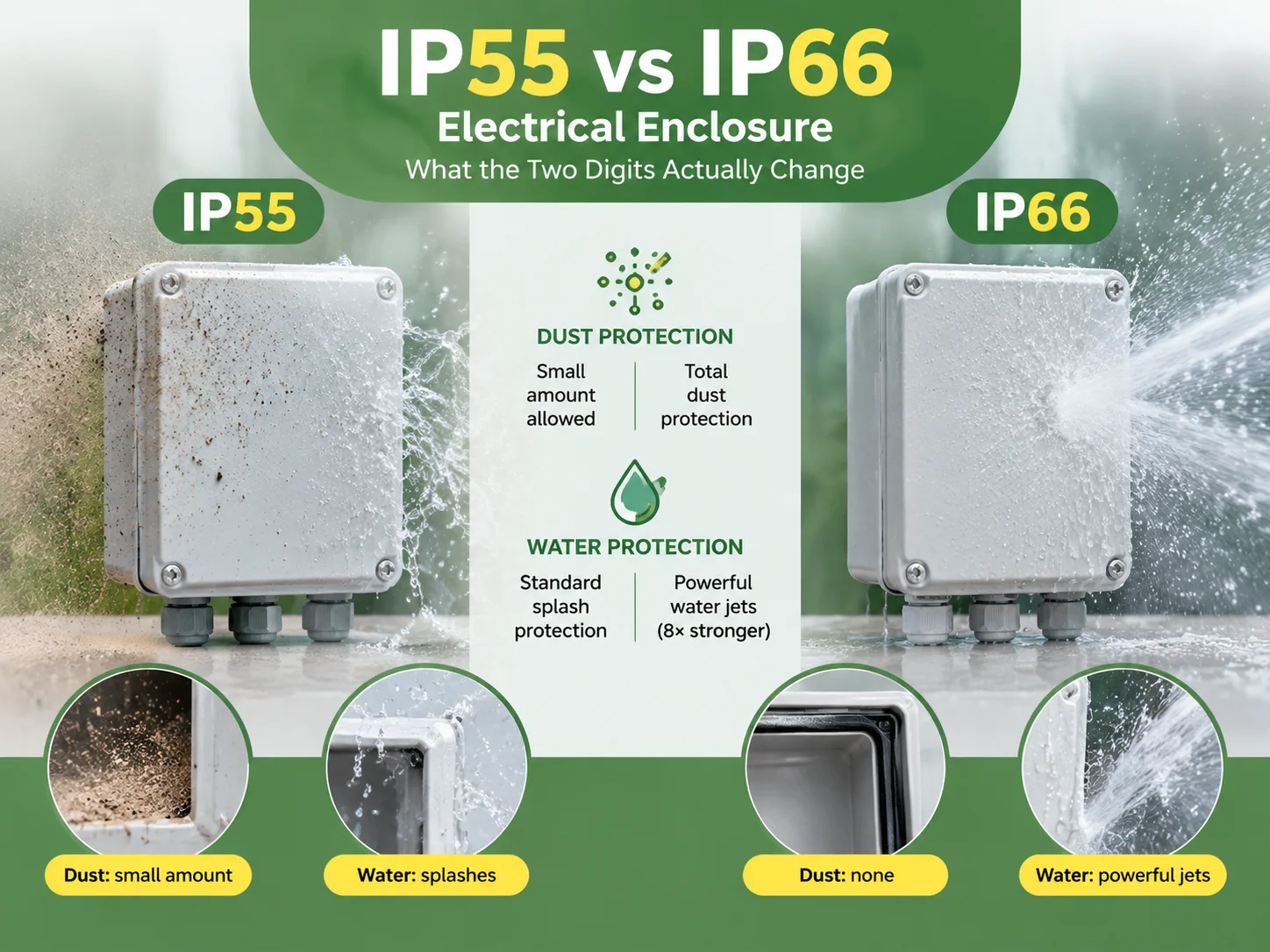
Read the two digits separately, because they are two different tests
As such, it is essential to evaluate the meaning of each number in the IP Code separately because they represent individual test ratings. A product could be outstanding in one category while being of mediocre quality in another category and rating the two together would then provide an average score which would only indicate that one product was inferior. For enclosures, the first number of the rating will be important when working in an environment with dust, such as cement plants, flour handling, woodworking, foundries, etc. The second number will be the primary number when where the water is getting onto the enclosure under pressure like in washdown work areas, vehicle yards, coastal sites, and roofs.
| Code | First digit | Second digit | Practical reading |
|---|---|---|---|
| IP54 | 5 dust protected | 4 splashing water | sheltered indoor or covered outdoor |
| IP55 | 5 dust protected | 5 water jets | outdoor with a roof, general industrial |
| IP65 | 6 dust tight | 5 water jets | dusty industrial, outdoor systems |
| IP66 | 6 dust tight | 6 powerful jets | washdown, exposed coastal, heavy weather |
The table below depicts the two comparisons that are made and are made in error by most buyers. IP55 and IP65 have the same rating for water protection. The main difference is the dust protection. IP65 and IP66 have the same rating for dust protection. The main difference is the water pressure rating. Therefore, if a buyer were to upgrade from IP55 to IP66, they would actually be upgrading twice if only one of those ratings were required at the time of purchase; therefore, they would be wasting money on one of those upgrades.
What IP55 actually certifies
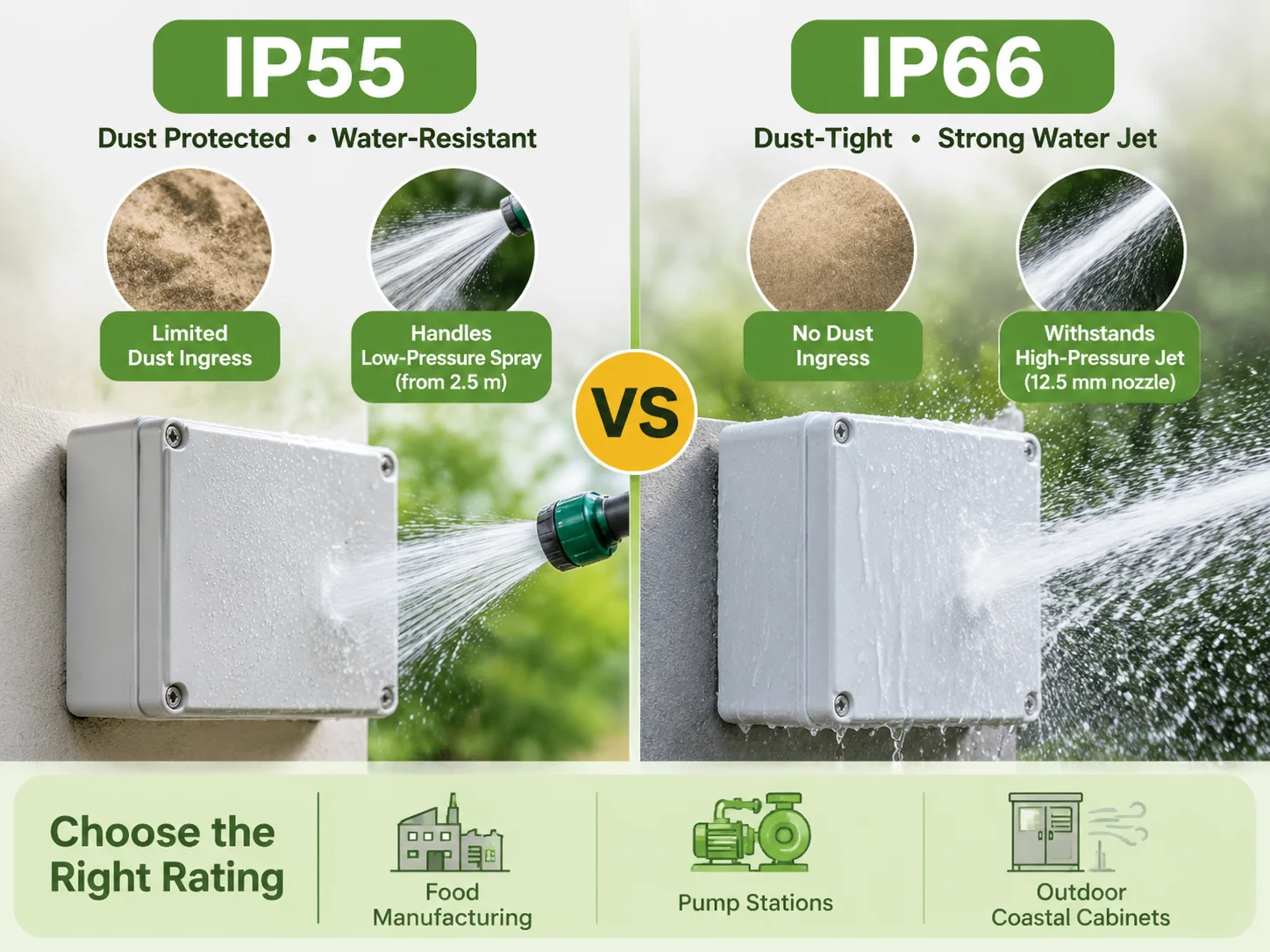
An enclosure rated IP55 permits limited dust to enter the enclosure if the dust does not interfere with the satisfactory operation of the enclosure or deposit in a location where it could create a hazardous condition. In practice, a well constructed enclosure rated IP55 will keep most all of the dust out through the use of gaskets and overlapping flanges, however, the enclosure will not be dust-tight for continuously entering dust in negligible amounts for several years.
When an enclosure has an IP55 rating, it will prevent water from entering at a lower height than 2.5 m when being sprayed horizontally with a garden hose provided the hose has a minimum internal diameter (ID) of 6.3 mm and provides a minimum flow rate/pressure maintained for 3 min. The test for IP55 did not specify the relationship or incorporate minimum restrictions on hose distance and angle of force application. A water pressure of 100 kPa against a box rated IP5X would not withstand the impact of the hose spray.
What IP66 actually certifies
The actual performance of the IP66 certification for an enclosure is limited compared to the water ingress protection of the IP55 certification. The first 6 indicates the enclosure is dust-tight; a dust-proof enclosure stops any amount of dust from entering under normal operating conditions. A box that fails this test (for example, fails a 3 minute dust exposure as defined by the use of a dust tester) will not be able to keep out water and/or moisture, until an appropriate enclosure type is constructed to hold back moisture.
The second 6 of this certification is established under laboratory conditions by applying 12.5 mm (1/2″) water jet pressure at 100 litres/minute (260 Litres) (not gallons) with 100 kPa (14.5 PSI) from the 2.5 to 3 metre height from which the test was applied to the enclosure for a minimum of 3 minutes (1 minute for each test point).
Compared to the testing method used for IPX5, the IP66 testing has the relatively larger diameter (12.5 mm against 6.3 mm) nozzle, the very large volume and higher jet pressure being introduced onto the enclosure for a longer period of time.
Enclosures rated IP66 do not provide any protection from being filled with water to greater than 0.5 metre of standing water against which the water flow from the jet is applied continuously for a period of 3 minutes. However, to have an enclosure rated at 100 kPa, will not indicate that it will not have the potential issue when it comes to having an IP66-type enclosure submerged under greater than 0.5 metres of standing water. An IP67 rating is required for short-term flooding; IP68 ratings are necessary for constant immersion.
Why should you consider the additional cost for the higher rating? Here’s an example: In a food manufacturing facility, the floor of a washdown bay (where you wash down equipment after use) has daily hosing down; this means you need a higher rating. In a pump station, because it is cleaned weekly, the pump station floors require the use of a higher-rated enclosure, and then you have the coastal-cabinet outdoors facing wind-driven rain at 20 m/s.
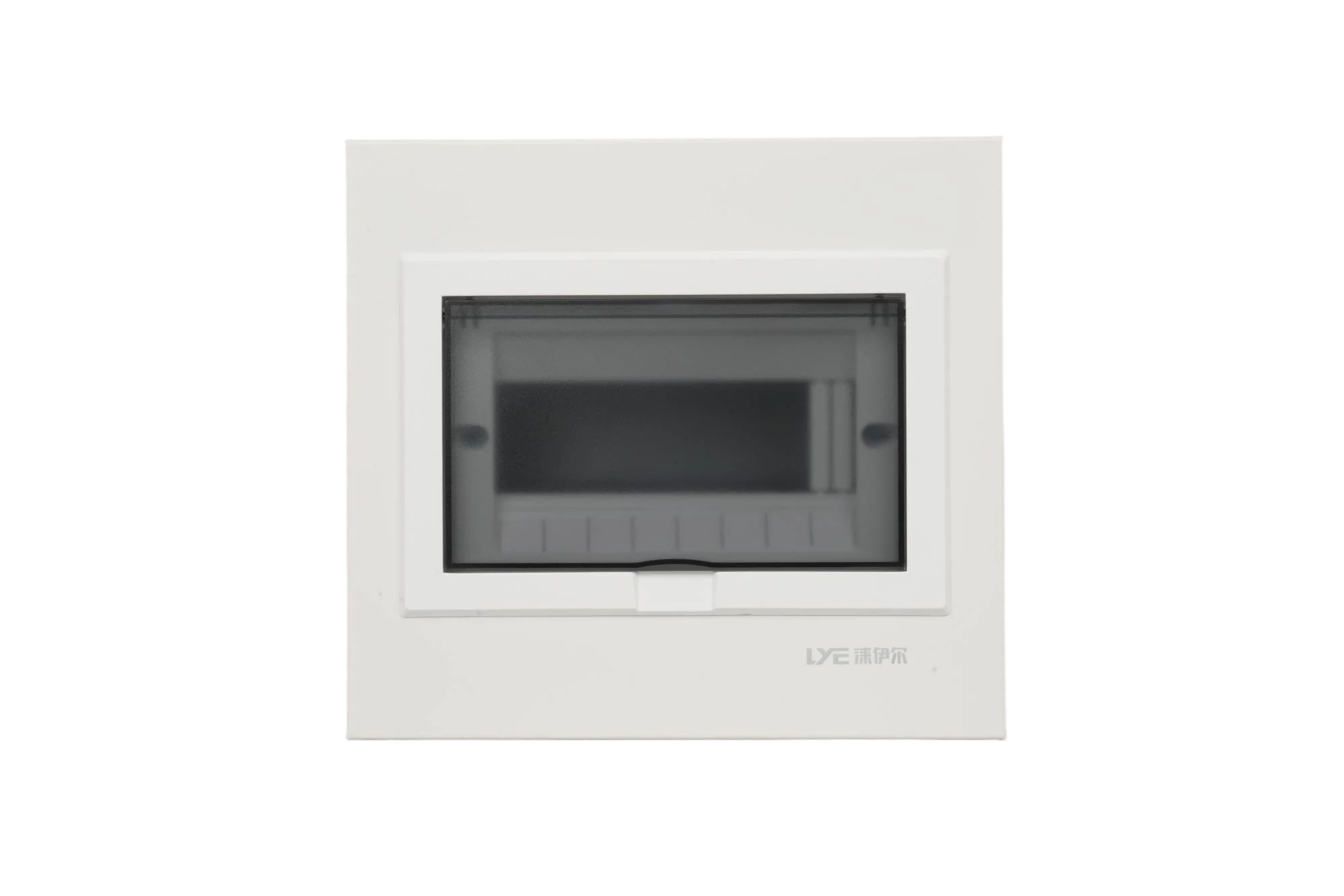
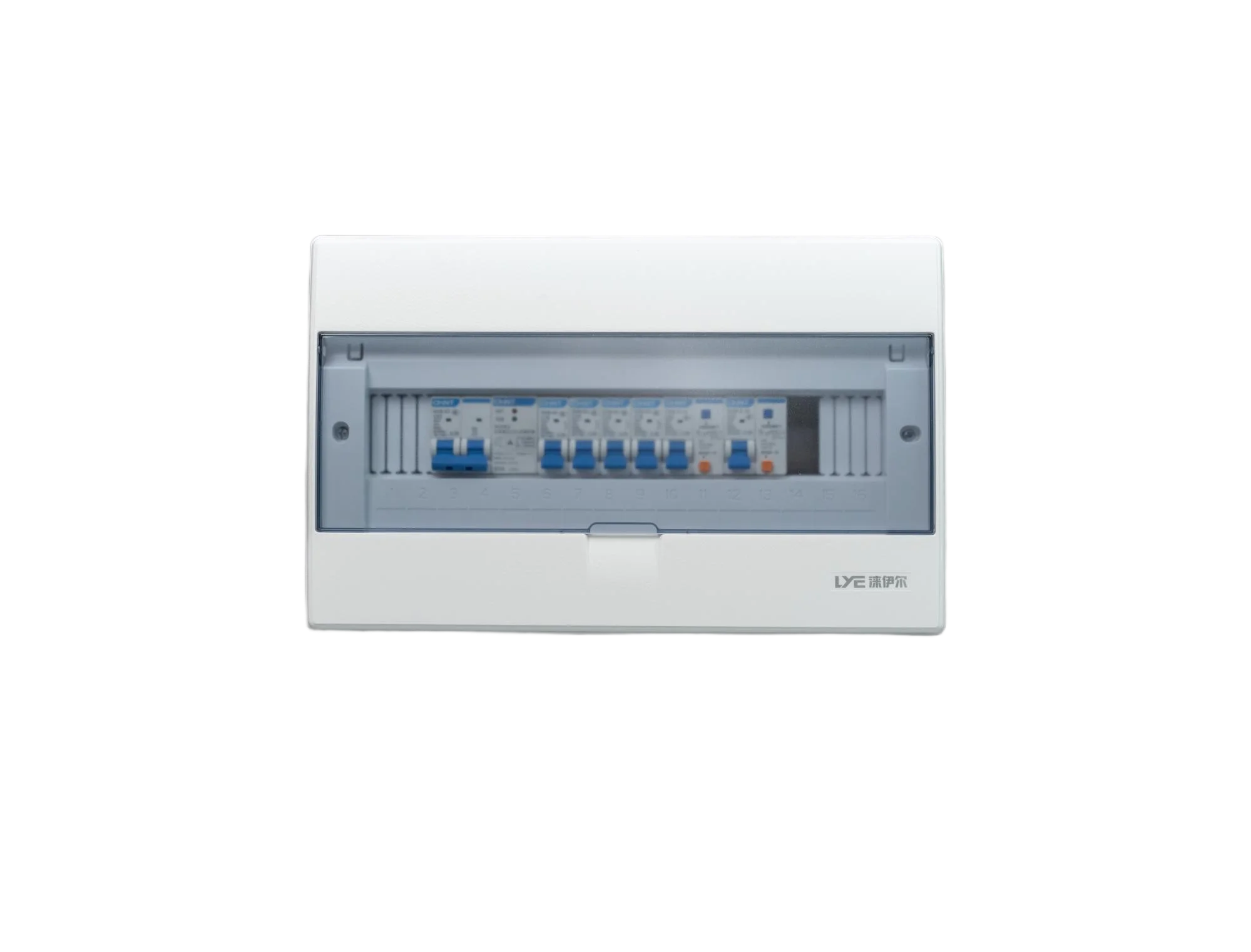
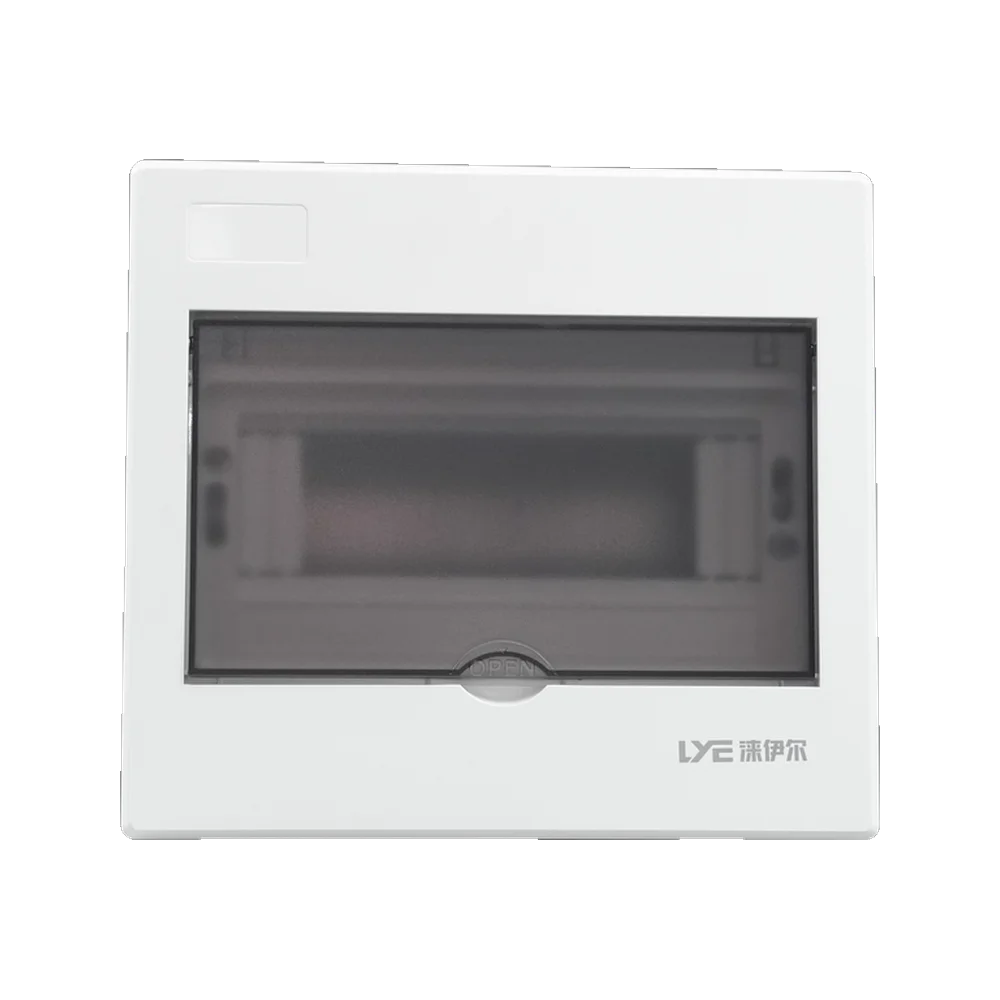
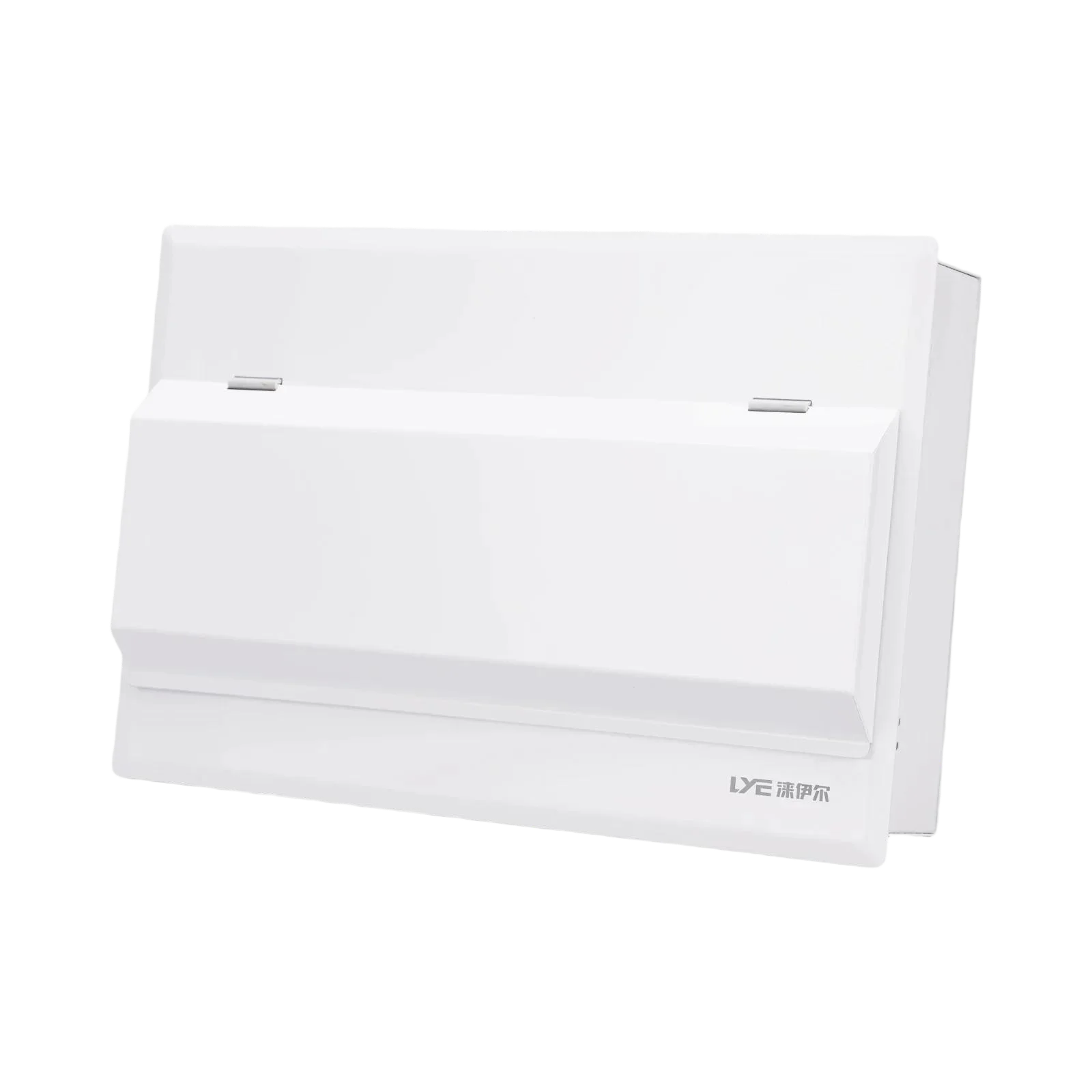
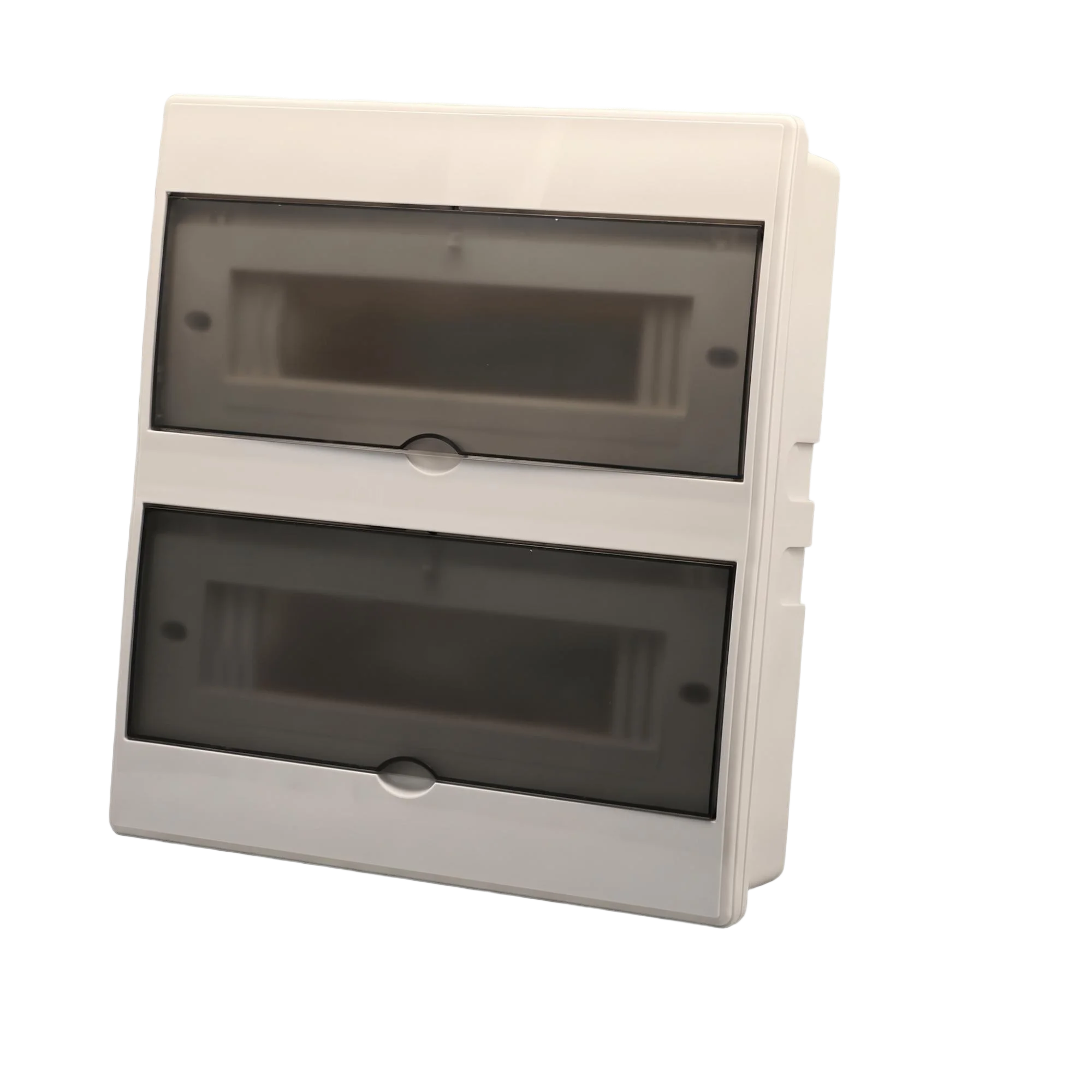
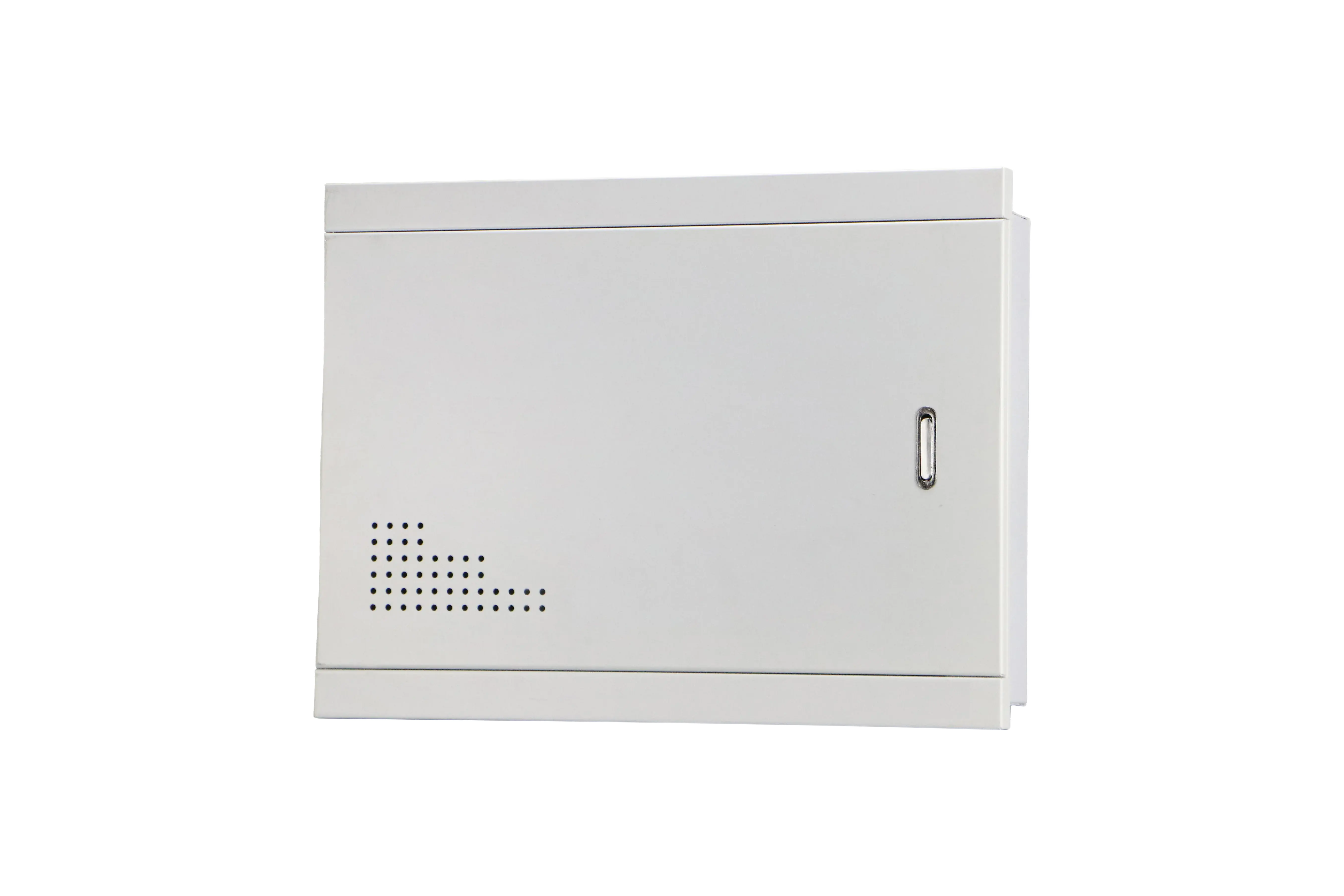
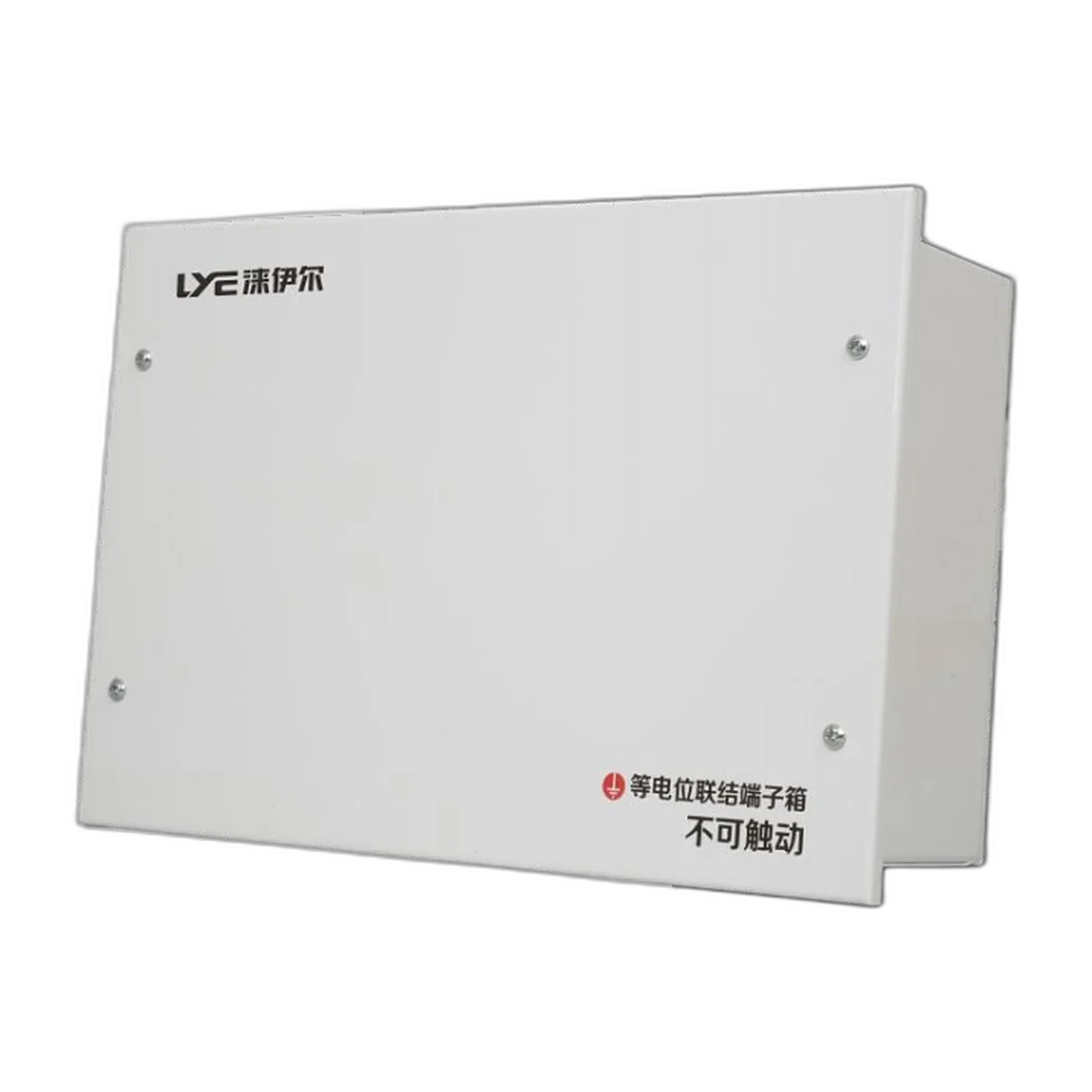
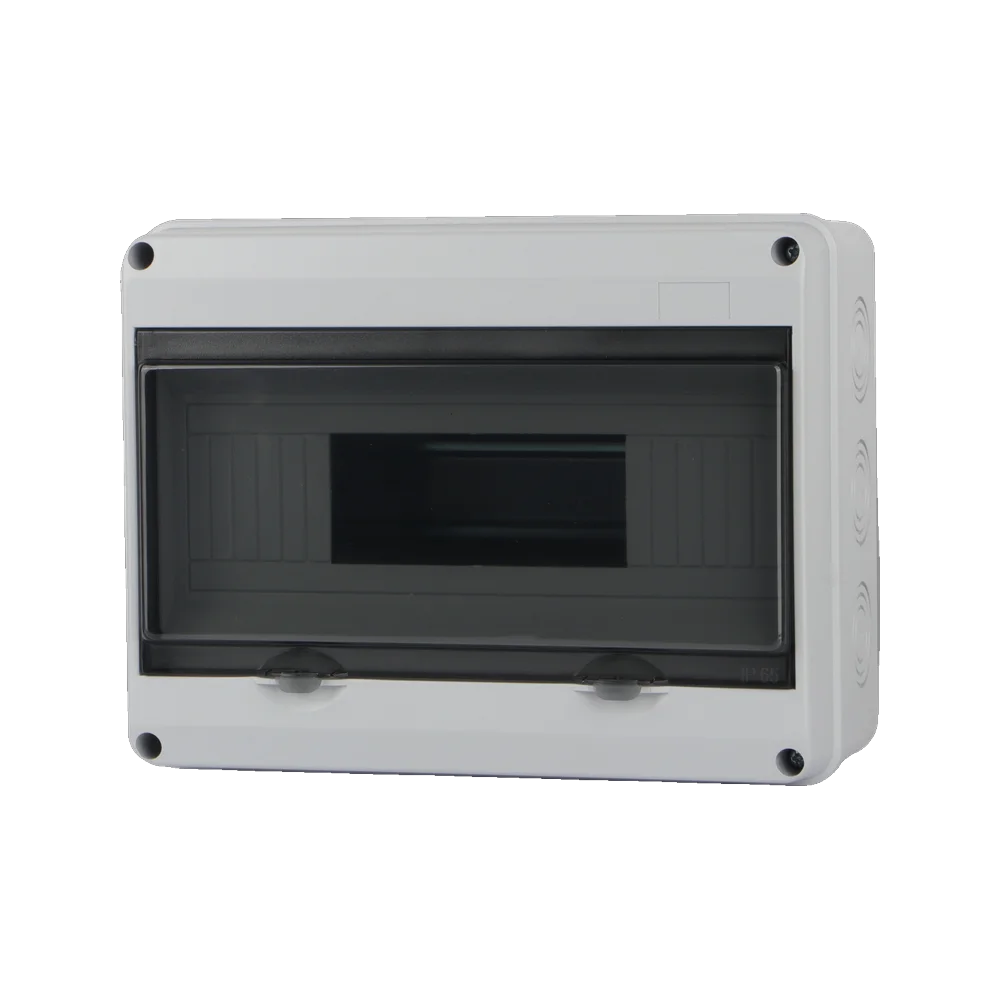
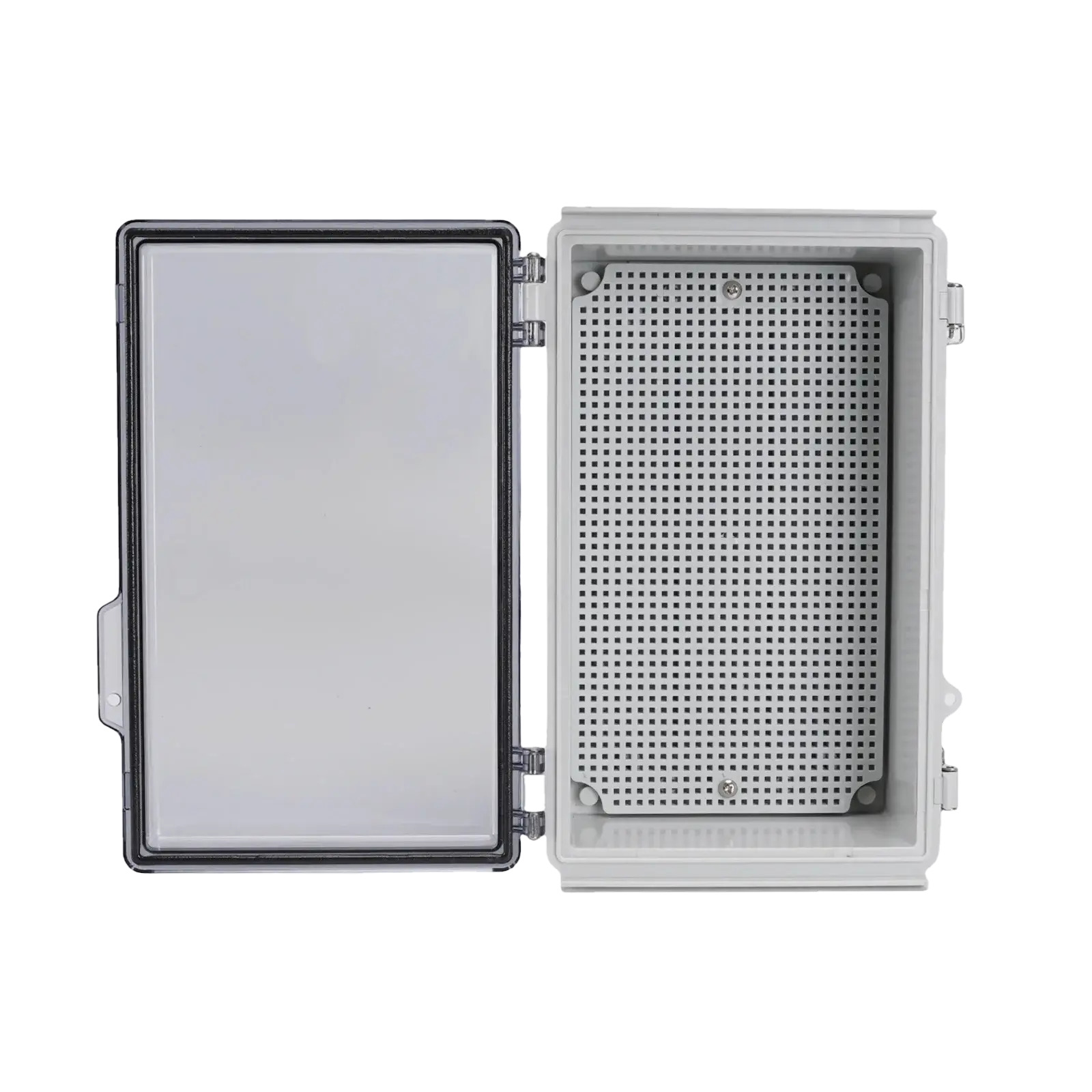
As of October 2023, we offer a complete range of full-plastic/polycarbonate enclosures — LYC5 IP66 (available in transparent) is available in sizes from 150 × 100 × 70 mm through to 510 × 410 × 200 mm. In addition, the opaque version of LYC5 — IP66 enclosures is available throughout.
The difference in millimetres and litres per minute
Comparing the two ratings in litres per minute (L/min) and millimetres (mm) for an enclosure can sometimes lead buyers to confuse the two ratings for the same type of enclosure. Buyers often reference the data sheets when comparing two enclosures with an IP55 (second digit 5) and IP66 (second digit 6) rating assuming there is a relationship between the two. However, the two ratings are not compared based on a linear scale. The table below, which depicts the differences in flow rate and the nozzle bore size, will be helpful to present to a customer wanting to know why the IP66 rated enclosure is more expensive than an IP55 rated enclosure.
| Parameter | IPX5 (second digit 5) | IPX6 (second digit 6) |
|---|---|---|
| Nozzle bore | 6.3 mm | 12.5 mm |
| Flow rate | 12.5 L/min | 100 L/min |
| Pressure at nozzle | 30 kPa | 100 kPa |
| Distance | 2.5–3 m | 2.5–3 m |
| Duration | ≥3 min per m² | ≥3 min per m² |
The eight times more flow associated with an IP66 rating is an important number to keep in mind when determining the level of seal needed for your product’s enclosure. The gasket design of 12.5 Liters / minute would be flat profile, and moderate compression. At 100 Liters / Minute flow it deflects from being hit by the jet, which is why all IP66 Enclosures have a molded channel gasket, greater latch count, and in general, coarser threads on their screws.
Where IP55 is enough, and where it is not
IP55 Enclosures can be used in many installations that are not included in the marketing; such as, a wall-mounted power distribution box under a roof overhang, A power panel mounted on a wall within an industrial building with a roof overhang, A junction box mounted on a pole located in a temperate climate. Using IP66 Enclosures would increase costs to the end user who would be paying for a level of protection that there is no need for.
The distinction of whether to use IP66 or IP55 is not simply the indoor/outdoor distinction, but more about how the water is delivered to the enclosure. Rain falling vertically is handled by any IP55 Enclosure that has a drip edge, but rain falling horizontally at speed or water delivered via a hose is a different load. Vertical rain is considered “Weather,” Horizontal driven rain is considered “Washing.”
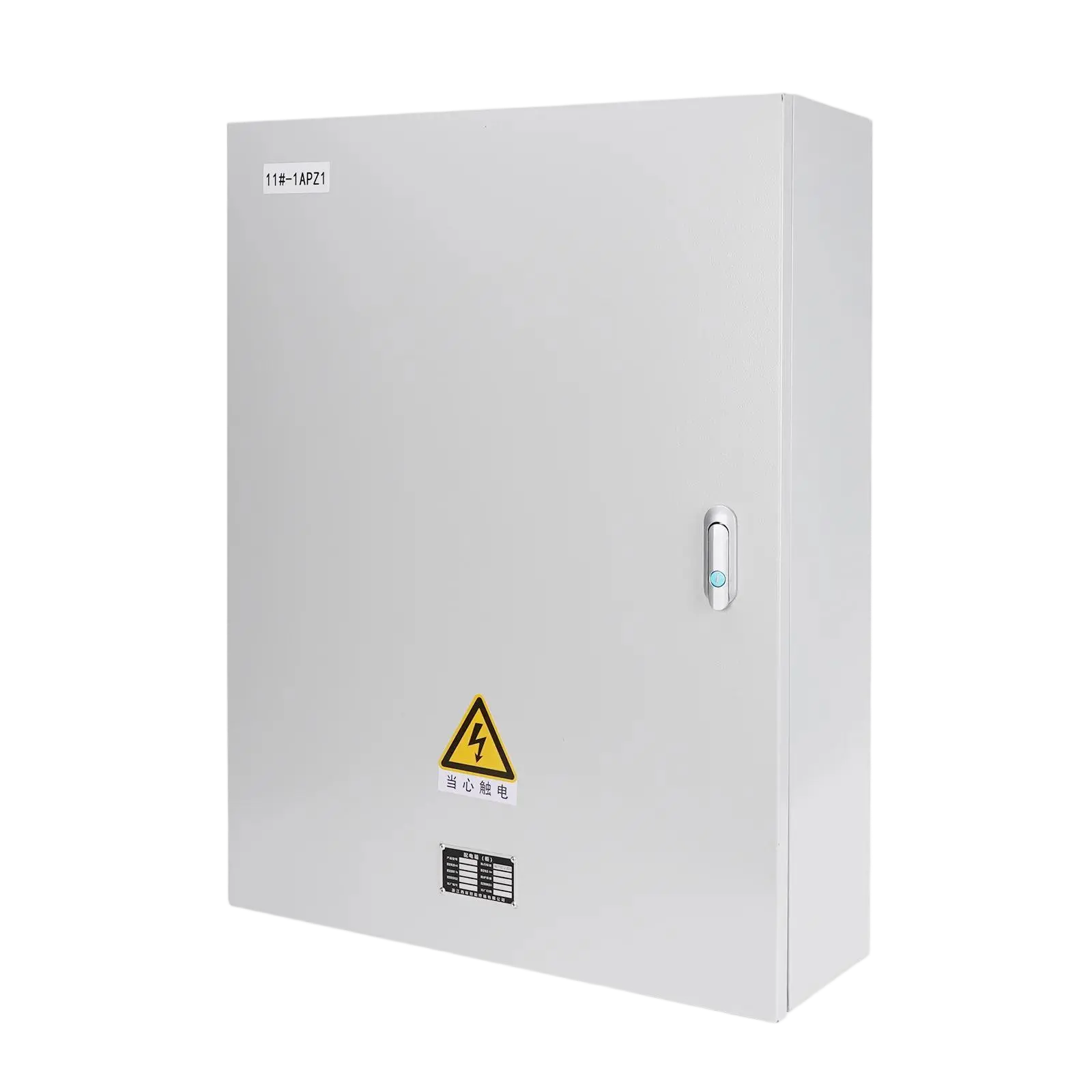
There are three applications on a Normal Project that justify use of IP66 rated enclosures, they are: A cabinet mounted at floor level located in an area that will be washed with a high pressure hose down; An enclosure to be installed within 200m of open ocean, where the sea breeze carries salt that can and will create a conductive film when it deposits on the enclosure. Seasonal Cleaning of enclosures with a pressure washer. In any other circumstance, IP55 or IP65 rated enclosures will provide a better engineering solution and the money saved can be invested in a stainless or UV stabilized enclosure body.
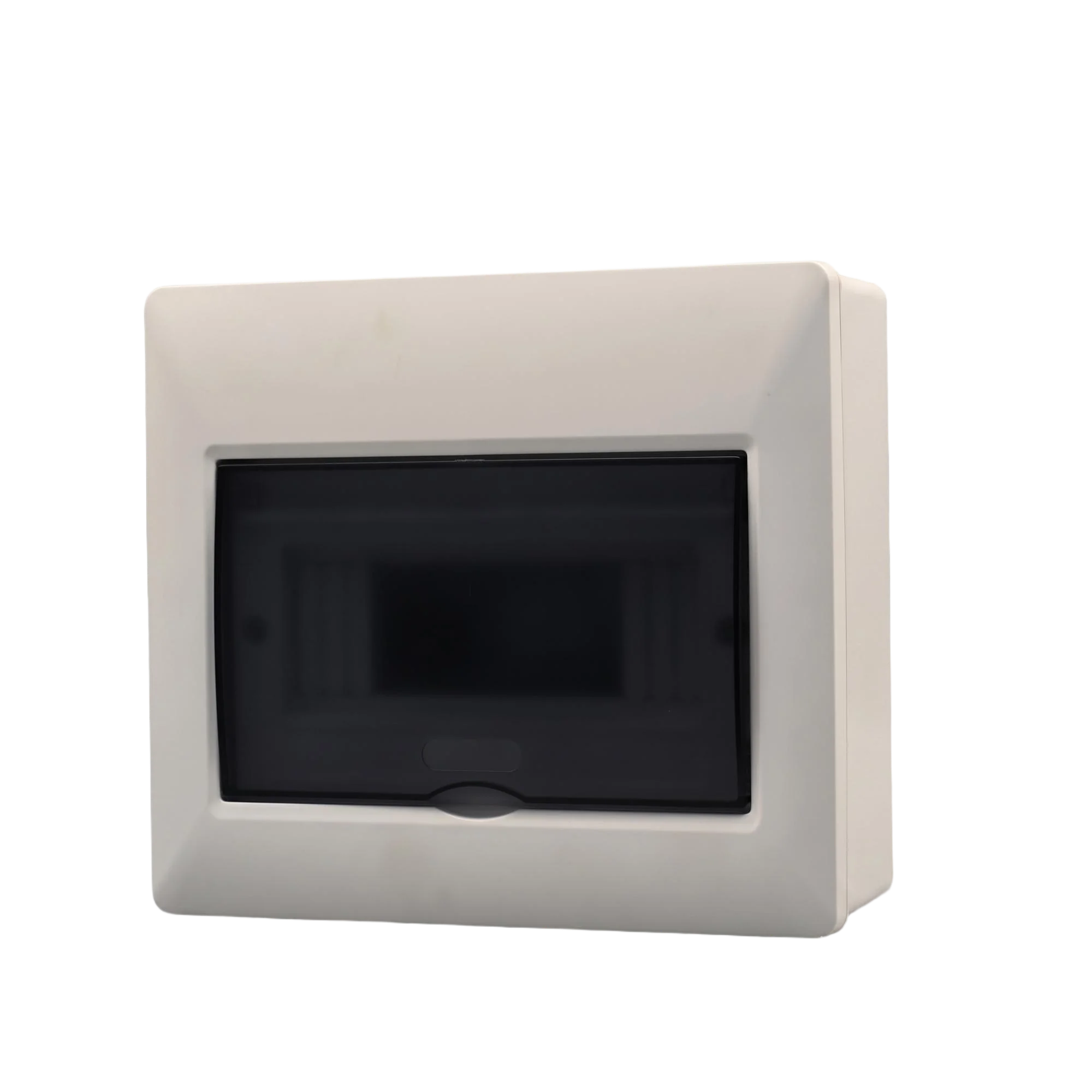
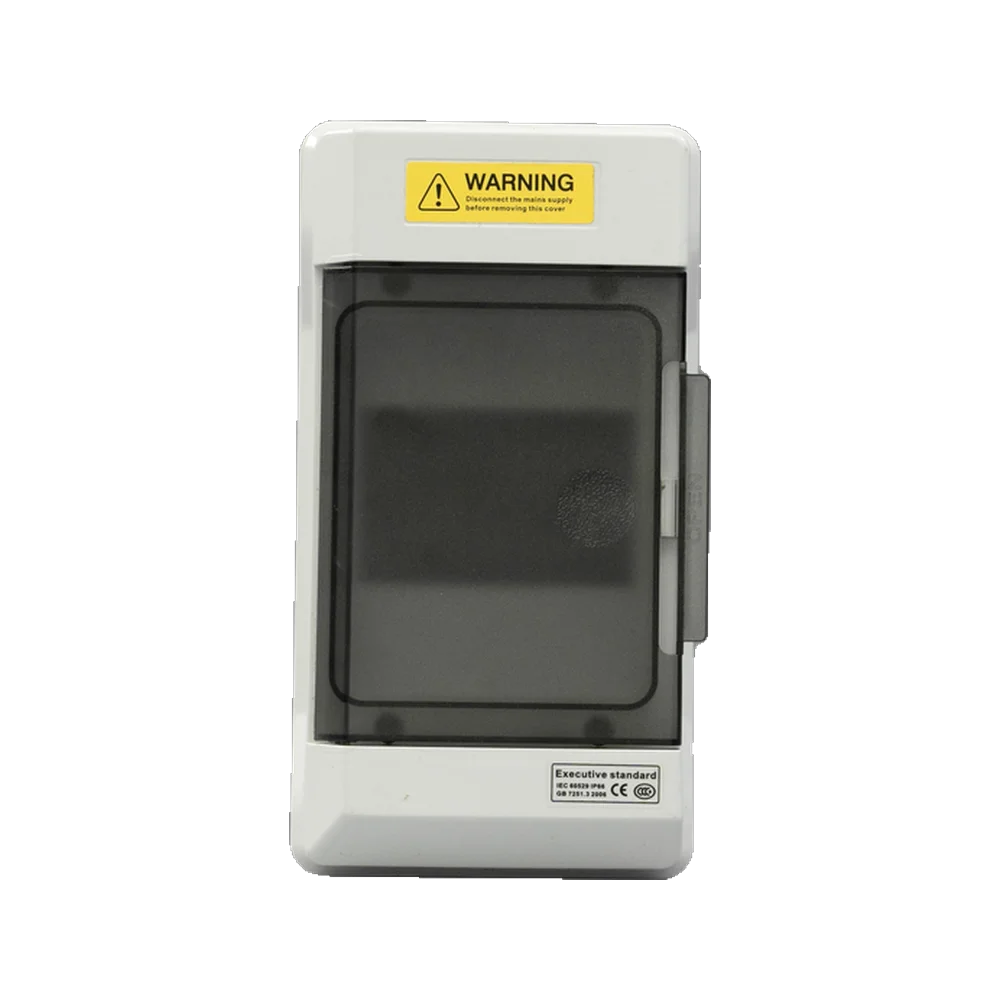
The practical response for a mid-range application dusty but not washed, Outdoor but not exposed to the elements, then the right answer will be IP65. This is true because the dust digit will fail before the second digit (waterproofing) fails to protect the equipment for years to come. The LYC2 IP65 Waterproof Outdoor Distribution Box fits this middle of this range of IP Rating & specified waterproofness combined with IPX5 rated water rating and increases the Dust Rating to 6.
Materials: the rating depends on the seal, not the plastic
Materials for the rating of an enclosure are determined by how well the seal that is made on the plastic is, not by what type of plastic it is. Therefore, an IP66 rating is a characteristic of the assembled enclosure itself and not a property of the plastic it is made out of. For example, two similar plastic enclosures that are both made out of ABS, may have different IP ratings. One enclosure may have a channel gasket, and 6 latches & the second enclosure has a flat gasket and 2 latches, even though they are made from the same material (ABS).
The material used will determine how long the rating is good for. ABS is cheap and dimensionally stable, but it degrades under UV unless a stabiliser is added; therefore, an unstabilised ABS enclosure will yellow and get brittle if left in direct sunlight after approximately 3 to 5 years. If a latch should crack or fail then this will allow water to enter the enclosure preventing it from being watertight. Polycarbonate is more durable and has a longer lifespan outdoors. If there is a corrosive rather than wet environment, the enclosures have to be made from Stainless Steel. (For example, coastal air, Chemical Plants, or washing food with chlorinated water).
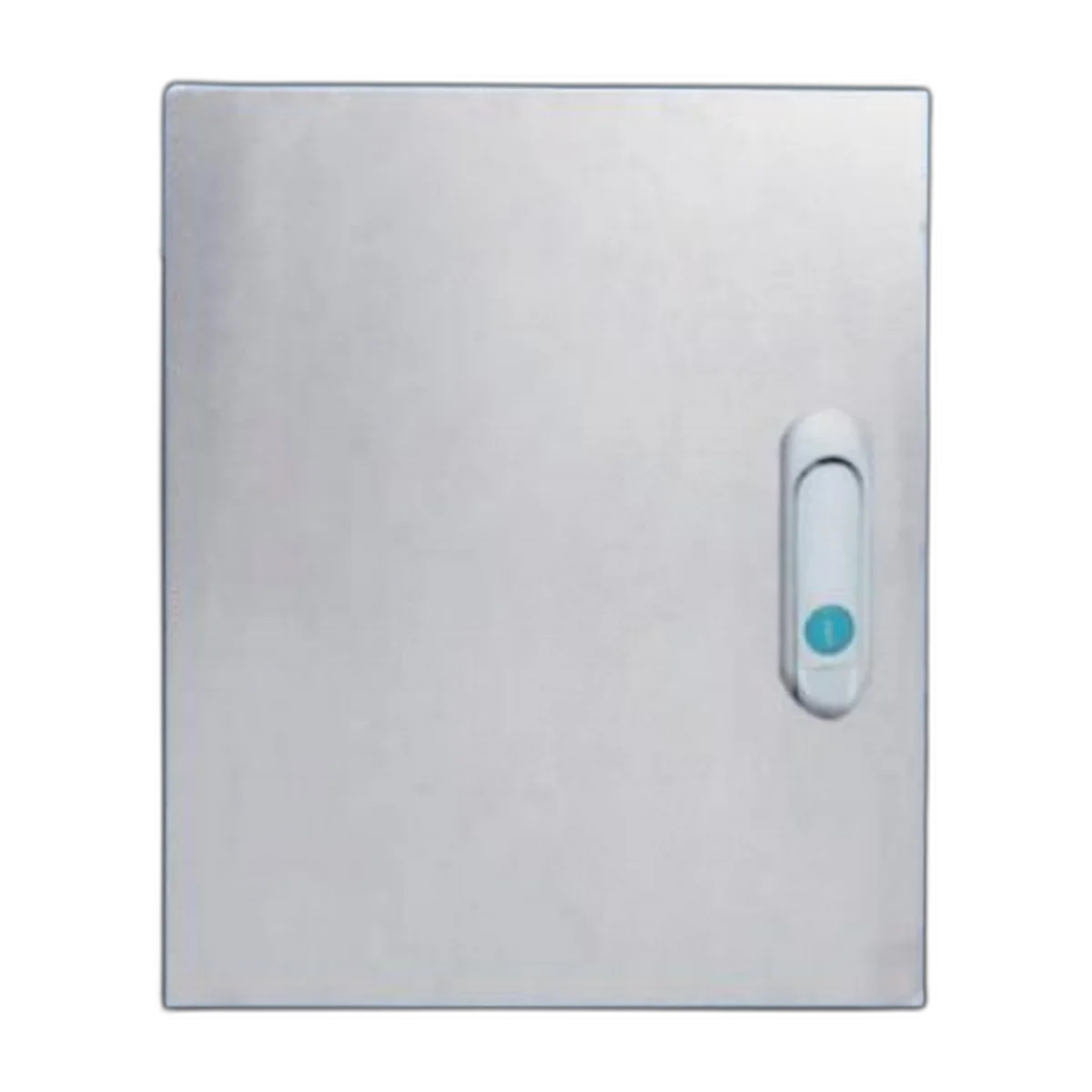
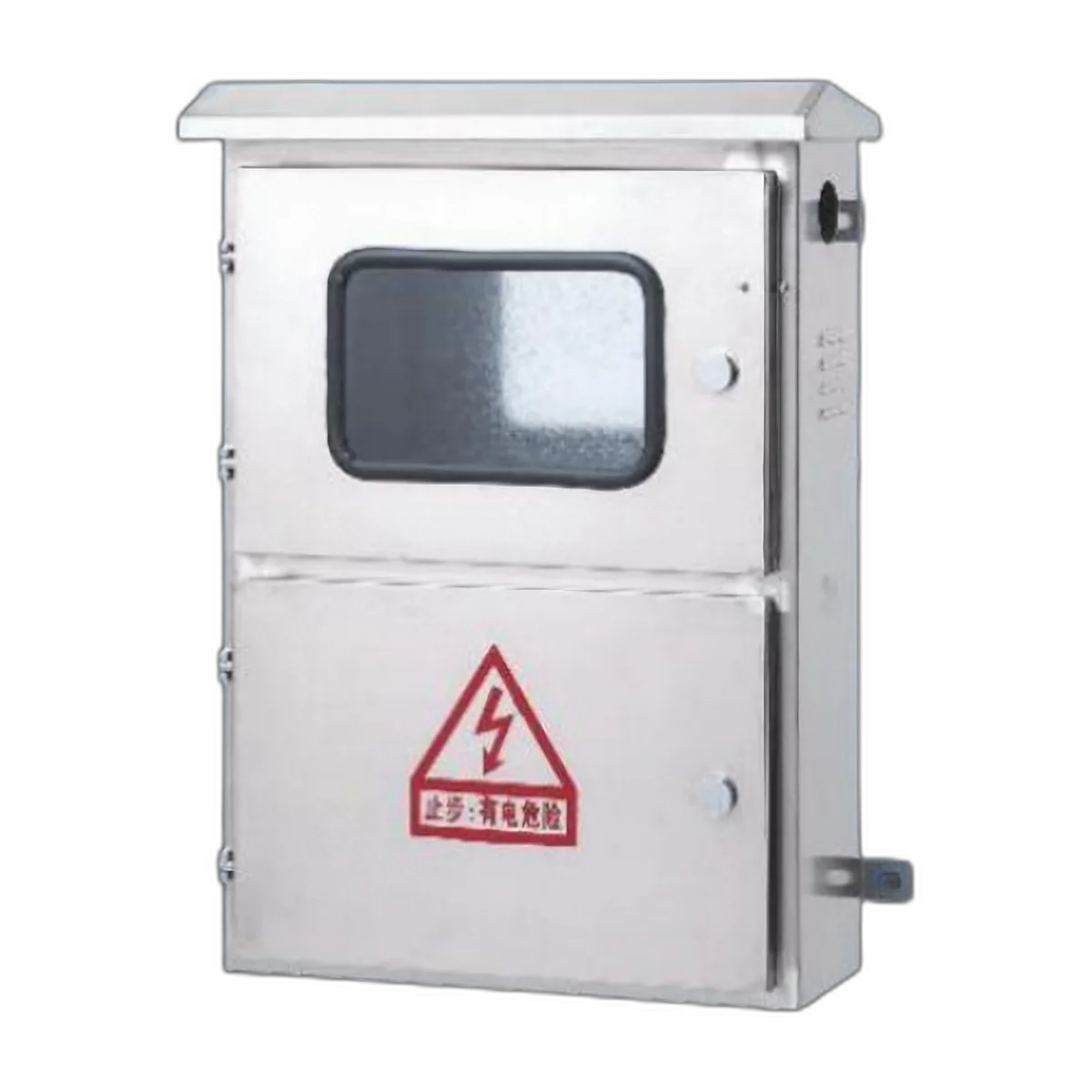
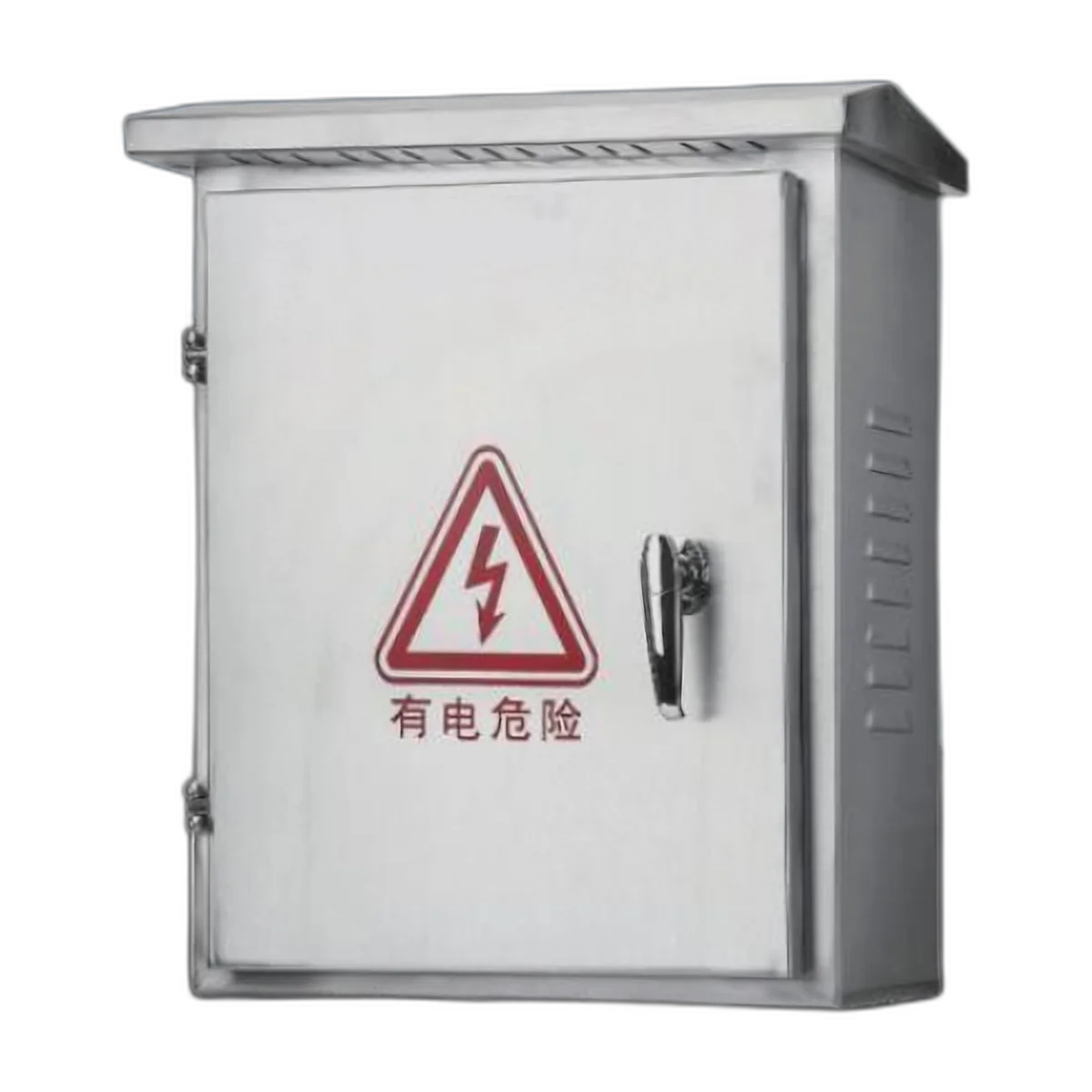
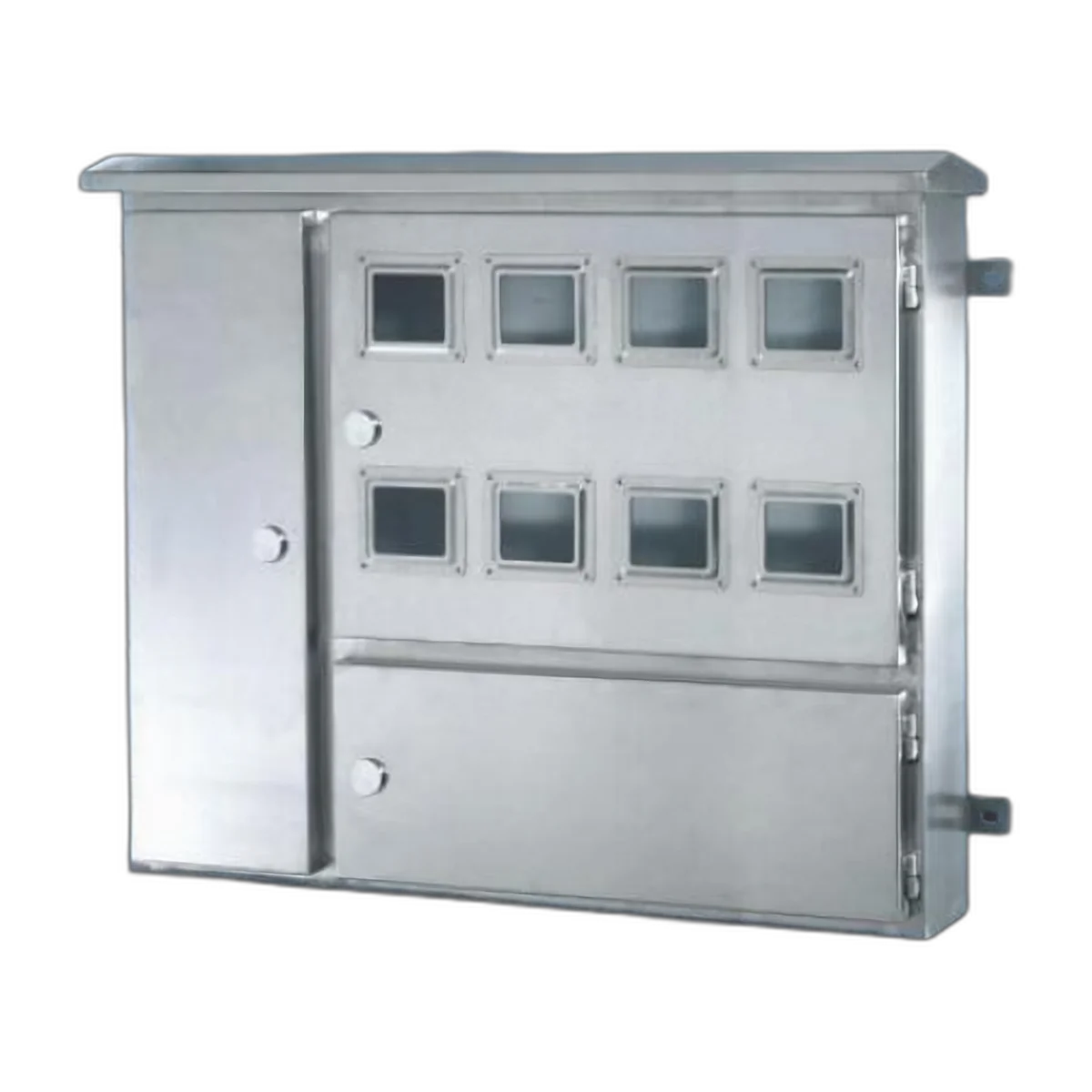
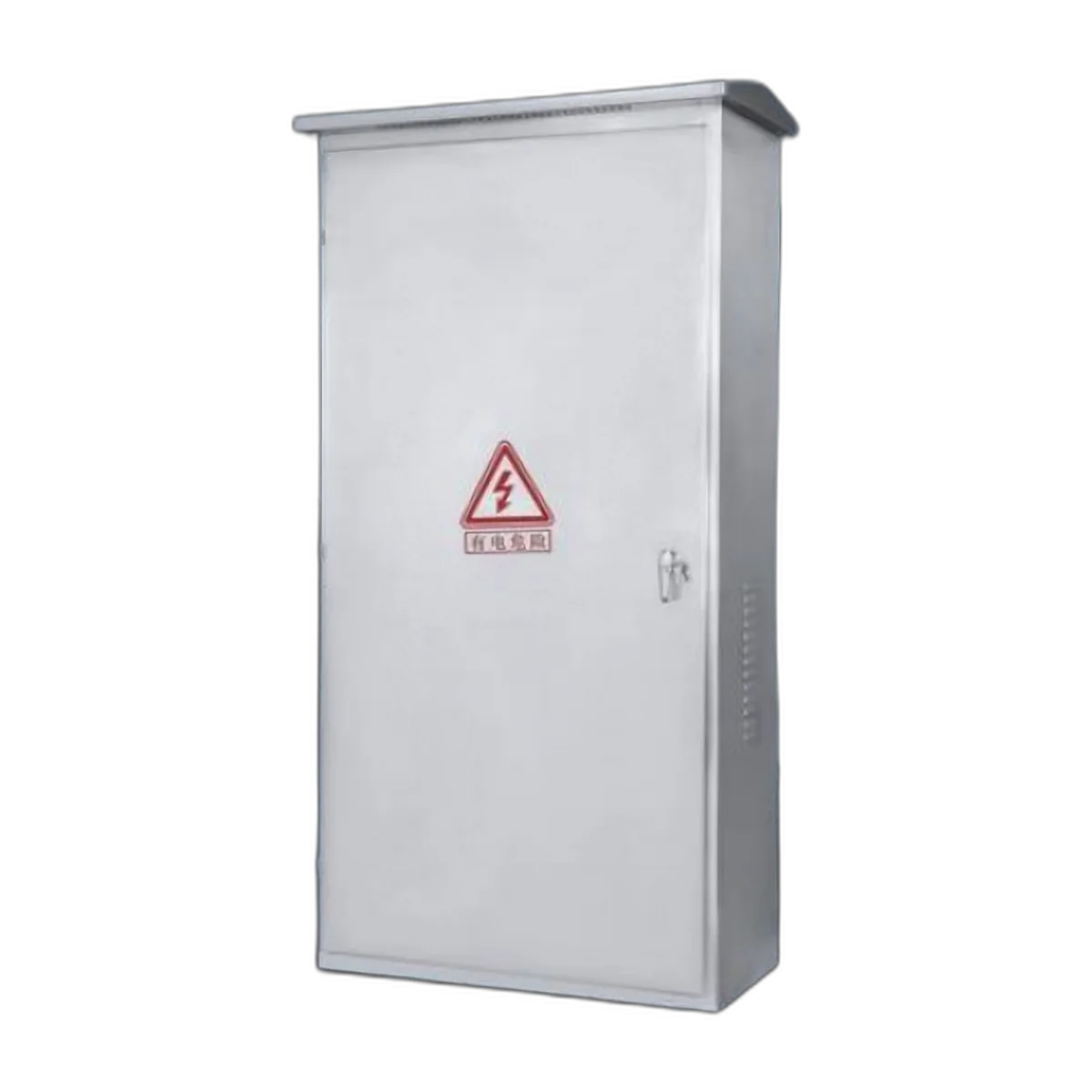
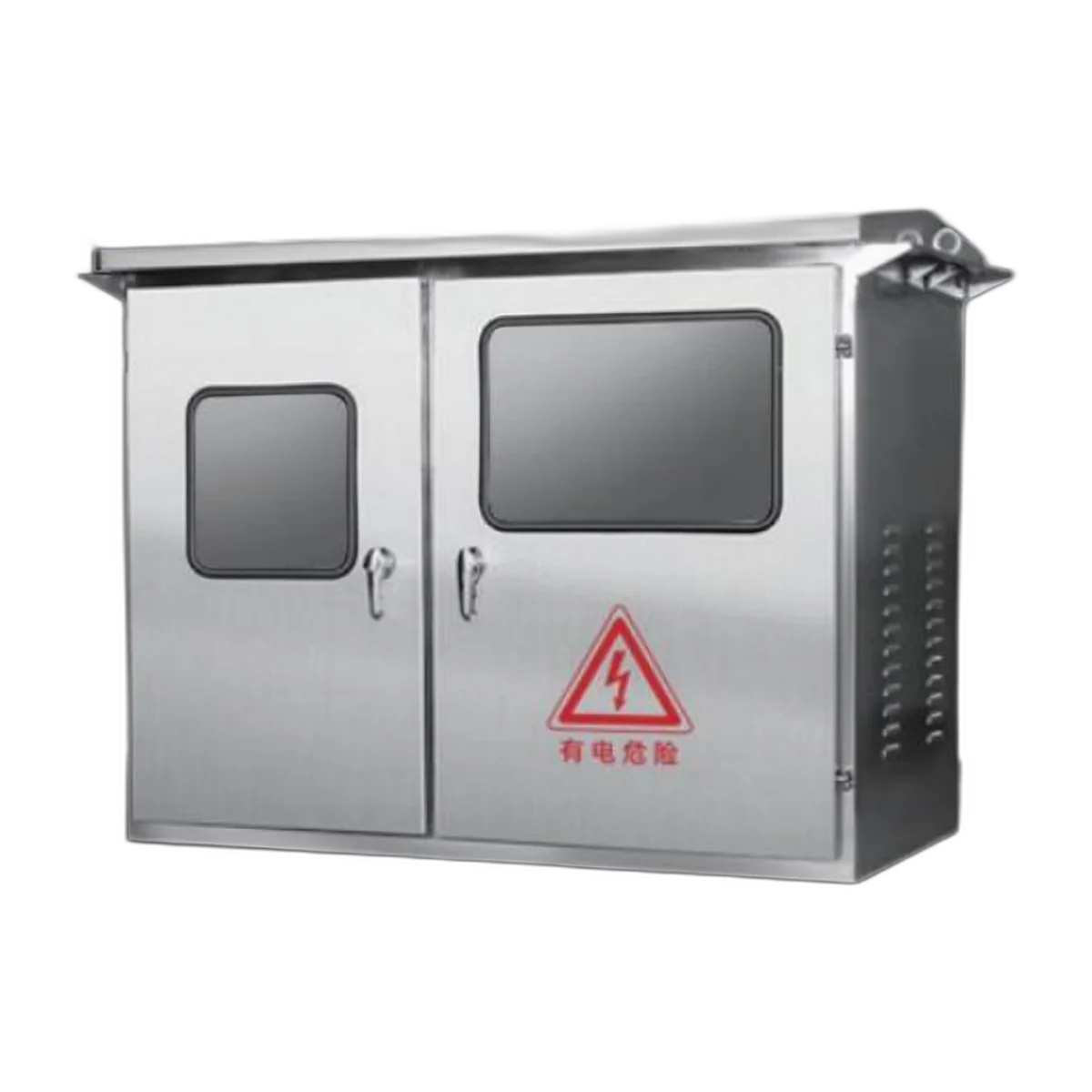
The material also affects how the enclosure will fail. For example, a plastic box that loses its gasket will allow water to enter very slowly as opposed to a steel box that has an area that rusted at the weld. In this case the water will enter through the wall of the enclosure. A coastal site will have a higher preference for stainless steel with IP55 rating than plastic with IP66 rating. The main reason for this preference is the failure mechanism of plastic versus the failure mechanism of stainless steel. The mode of failure for plastic enclosures is through ultraviolet (UV) light, while for stainless steel, it is through weld failures which can typically be inspected. This is why we offer both JXFS stainless steel distribution boxes as well as the plastic families within this product range.
Size and wall thickness: why IP66 boxes are bigger
There are two geometric factors that contribute to the increase in size of IP66 enclosures relative to similar sized IP55 enclosures.
The first factor related to size is the gasket used for sealing. A channel type gasket has a much wider flange than a flat type gasket. As a result, an IP66 enclosure will require an added dimension to its footprint from the edges of the flanges to provide sufficient seating area for the channel gasket, usually in the form of an additional 8 to 15mm on each side. A flat gasket provides a larger amount of sealing surface than the channel type and, as such, the equivalent size IP55 enclosure will generally have a thinner overall profile than a comparable size IP66 enclosure.
The second factor contributing to size increases is latch positioning. The test for IPX6 involves a deflection of the lid between mounting latches, resulting in reduced maximum unsupported span limits as a result of increased rating. Therefore, while the lid for an IP55 rated enclosure may have four latches, the same configuration of enclosure rated to an IP66 will typically require six or eight latches, and the corner geometry must accommodate the number of latches used.
As a result of the above two factors, when comparing the IP55 and IP66 versions of a particular enclosure, they will normally not be interchangeable when installing on a wall. Depending on the length of time that the particular enclosure is specified, there could be differences in the locations of the fixing centres, number of latch locations, and entries for cabling, meaning that if an enclosure specified for upgrade from an original product has already been cut to fit, it will not fit properly into the hole previously cut.
Price: what the extra spend actually buys
The premium paid for an enclosure rated as IP66 over the same style/size material as IP55 generally varies between 30 and 60% depending upon each application; and this cost is not apportioned evenly due to the nature of each enclosure’s construction or design.
Most of the additional expense associated with an enclosure rated as IP66 can be attributed to the level of protection provided through its seal and hardware. Many of the additional dollars are utilised to furnish the moulded design of a channel gasket, as opposed to a flat non-moulded version; additionally, there are often far more latches (stainless steel) used to fasten the enclosures than that found on an enclosure rated IP55 where plastic latches are employed; furthermore, the components for the gasket and latches are made from higher quality materials than the minimally acceptable level required for an enclosure rated as IP55, thus warranting the higher price associated with an enclosure rated as IP66.
Another large component of the higher cost of an enclosure rated as IP66 is that the higher level of testing required to support an enclosure rated as IP66 must have a third party stamp of approval/certification to be validated as such; a supplier without such a certificate only offers a supplier’s assertion, not a supplier rating.
Lastly, the difference between an enclosure rated IP55 and IP66 is attributed least by the raw material utilised to build the enclosures; whilst it may be true that the majority of enclosures rated IP66 are made of the same material as their respective cage version, there is less than one millimetre difference in wall thickness between the two styles; additionally, many buyers of enclosures rated as IP55 incorrectly assume that the majority of price differences between the two styles is attributable to raw materials, and thus often negotiate on the wrong basis.
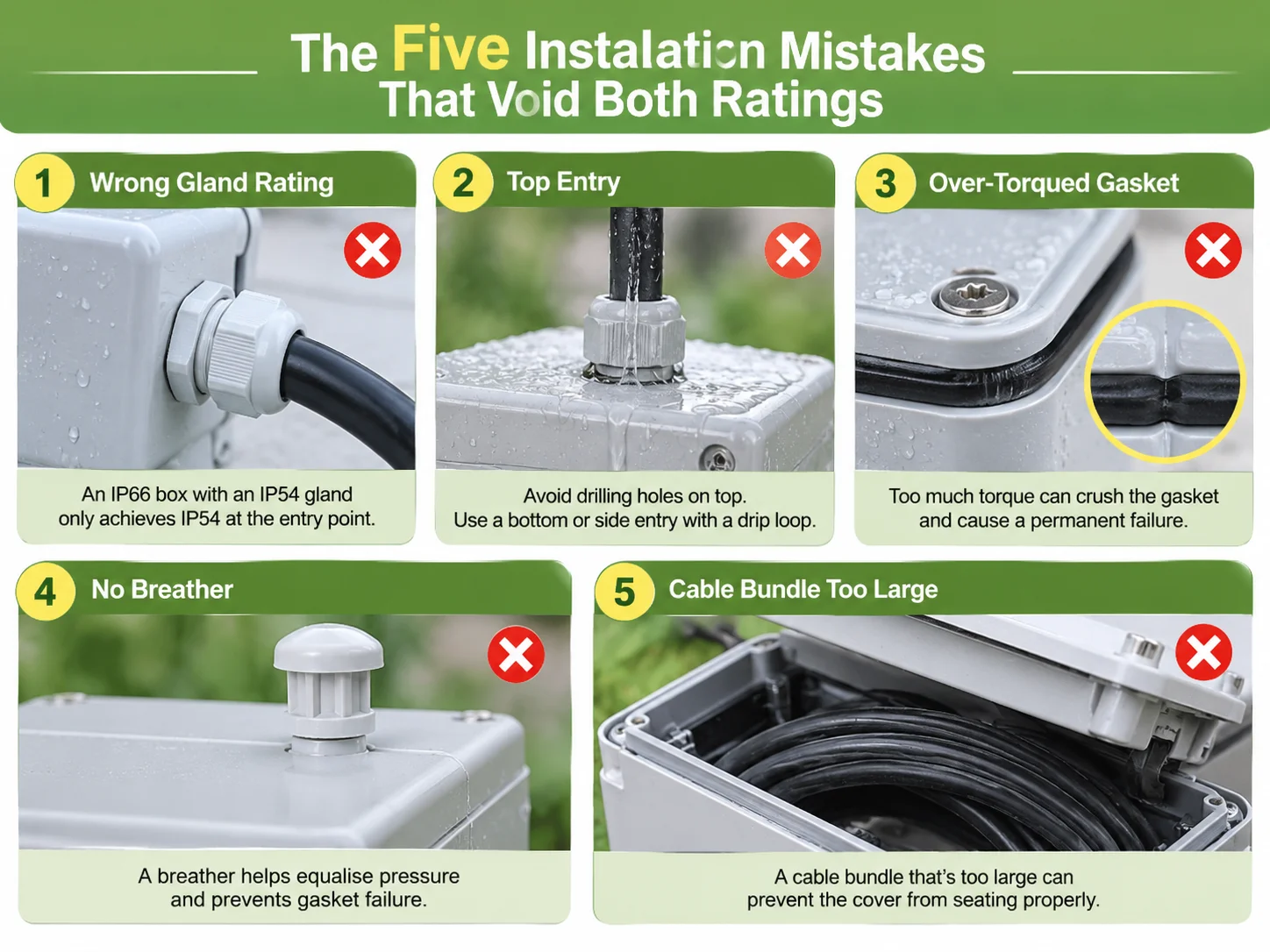
The five installation mistakes that void both ratings
A box with a rating of IP66 using an IP54 Gland with a rubber gasket will only have an IP54 rating where the gland enters the box and with a rubber gasket as a weak point, therefore a point of entry for water is from the weakest point, not the strongest.
A second point is where a hole has been drilled through the top of the enclosure for the entry of the gland/cable connection, with water streaming down the cable and pooling on the rubber gasket. The correct method of mounting a cable into an enclosure is from underneath or alongside with a drip loop.
The third point is where a gasket has been crushed due to improper torque being applied to the fastening mechanism of the enclosure. When too much torque is applied it causes the rubber gasket to extrude and create a permanent deformed set which will fail during the next thermal cycle; if there is excessive torque during installation, the next thermal cycle will see that the mechanical joining of the fastening mechanism will have failed.
Fourthly, the enclosure requires the addition of a breather. As the box heats and cools it will cause the air inside the box to transfer through the rubber gasket in order to maintain pressure equalisation. Without a breather fitted, this air is restricted and leads to gasket failure due to excessive cycling.
Fifthly and finally, if the cable bundle entering the enclosure is larger than the internal dimensions of the enclosure, it may not allow for proper seating of the cover due to the pressure of the bundle on the internal rim of the enclosure cover. The IP rating for an enclosure assumes the cover is allowed to seat properly. Frequently asked installation questions regarding glends and breathers can be found in the enclosure FAQ section.
How to specify, and what to ask the supplier
Creating an enclosure with the proper specification, requires only four lines in a contract, a specification with individual IP ratings for every position, not a single rating for the entire project. If the box will be used outdoors, it is advised to specify the material used and to state that it has to be UV resistant.
The gland is the most frequently downgraded element and, as such, always set out in the gland rating section of the specification. Always request a test report confirming the gland rating instead of relying solely on the datasheet.
The question that differentiates a legitimate supplier from a catalogue supplier is simple: what is the third-party test report that supports the gland rating (IP66) and does it include the size of the gland being ordered? Ratings obtained for one size of the gland do not automatically transfer to another size; the reason is the latch spacing and gasket span is different for each size.
For mixed position projects, the best course of action is to state two different ratings and therefore have two lines on the bill. A single IP66 rating for a project with multiple positions generally indicates that the purchaser has paid for a level of protection that is not necessary or that the supplier delivered an IP54-rated product but labelled it IP66. All technical data for the different families of products is available in the catalogue including the size table and the positioning of the glands for each family.
Frequently asked questions
Is IP66 better than IP55?
Yes, it is higher on both digits, therefore yes in an absolute sense. However, if the application requires the additional level of protection or not will determine which is the better rating to have. For example, a well-gasketed IP55 cabinet in a sheltered outdoor location could outlast a poorly installed IP66 cabinet.
Is IP65 the same as IP66?
No. While both IP65 and IP66 are rated dust-tight, IP65 is tested against jets of water at a rate of 12.5 litres per minute, whereas IP66 is tested against jets of water at a rate of 100 litres per minute. This difference in flow rate (eight times greater) is the key difference that separates hoses from pressure washers.
Can an IP66 enclosure be used outdoors in direct rain?
The performance of the IP66 enclosure is excellent in that type of environment, as it was designed for heavy rain. The tests for heavy rain usually include tests for vertical or moderate angles (i.e.inclined), which would typically be classified as IPX4 to IPX5. An IP66 enclosure was intended to protect from heavy rain driven by wind at very high speeds (high velocity or for three) and/or wash-down use, not to be used in normal weather conditions.
Does IP66 mean waterproof?
No. The IP66 enclosure is able to resist being hit with high-pressure water jets but will not protect from being submerged by water. For an enclosure that may be submerged, it is necessary to have an IP67 enclosure for the temporary immersion of the enclosure or an IP68 enclosure for the continued use while submerged. However, an IP67 and IP68 enclosure rating does not relieve you of the requirement of having the proper method of cable ingress and drainage.
Can I upgrade an IP55 box to IP66 by changing the gasket?
In many cases, it would be extremely difficult or impossible. In addition to the gasket being replaced, there are some design elements that cannot be changed from the original equipment manufacturer (OEM). The latch count, flange width and rib/angle of the lid, contribute to the assembly rating of an enclosure. An IP55 enclosure rating belongs to the entire assembly and cannot be transferred to the gasket alone.
References
- Saipwell — IP55 vs IP65 vs IP66 Outdoor Electrical Enclosure Guide
- Rittal — Enclosure Protection Categories and Selection
- Fibox — Polycarbonate and GRP Enclosures for Outdoor Use
- Hensel — Junction and Meter Boxes, IP Ratings Explained
- Intertek — Ingress Protection (IP) Testing and Certification
Conclusion
There are some differences between IP55 and IP66 enclosures; the most significant is the number of digits: one digit for dust, one digit for water pressure. The first digit to fail will typically be from a dust penetration in the industry and the last digit of the enclosure would likely be from a wash-down area, therefore, knowing which enclosure will meet both hazards will enable you to choose the right box without having to purchase two.
In most cases, a combination of the two is usually the answer. For example, choose the IP55 or IP65 for all locations that are sheltered from rain, choose the IP66 enclosure for locations that are exposed to rain, and spend the difference in construction costs in fabricating a more corrosion resistant body (e.g. stainless steel or UV-stabilised) for environments that are corrosive rather than wet. Be sure to also check the glands; many times an IP54 gland can change an IP66 enclosure into an IP54 installation where the actual water ingress occurs.